Showing posts with label 15th century. Show all posts

Thursday, 2 January 2014

Mystery People of History – Eleanor Cobham, Royal Witch

Have you heard of Eleanor Cobham, a woman from fairly humble origins who became a royal duchess and then lost everything when she was convicted of witchcraft?  Back in the 15th century probably the last thing you would expect to find in the English royal family would be a witch.  So you may be surprised to find that several royal ladies from this period were suspected of practising the dark arts, including Joan of Navarre who was accused by her son Henry V of plotting to use magic to kill him and Jacquetta Woodville who was said to have worked with her daughter Elizabeth to bring about her marriage to Edward IV by using sorcery and making lead images of the king.

Penance of Eleanor, Duchess of Gloucester in London
Eleanor Cobham, Duchess of Gloucester Does Penance


But how does Eleanor Cobham qualify as a mystery person of history?  Firstly there were the witchcraft charges brought against her.  Was she really guilty of dabbling in the occult or was she set up by an opposing faction at court who wanted to undermine the influence her husband, Humphrey Duke of Gloucester, had over the young King Henry VI.  Then there were the two illegitimate children of her royal husband, Arthur and Antigone Plantagenet. Was Eleanor Cobham their mother?  If so why were they not legitimised after Eleanor and Humphrey of Gloucester married, as the Beauforts were when John of Gaunt married his long-time mistress Katherine Swynford?

Eleanor Cobham was born in 1400.  Her parents were Sir Reginald Cobham of Sterborough and Eleanor Culpepper, his first wife.  She entered the service of Jacqueline, Countess of Hainault as a lady in waiting in the early 1420s.  The Countess had come to England by the invitation of King Henry V as she was trying to extricate herself from her marriage to her politically ineffective husband, John IV Duke of Brabant. She did manage to obtain a divorce in 1422, although its legality was never entirely certain, and she then entered into a hurried match with the new King Henry VI’s uncle, Humphrey Duke of Gloucester, early in 1423.  Jacqueline had hoped that her new royal husband would help her regain her lands in Holland and Zeeland, but Humphrey was acting as Regent to the new king who was still just a child.  The Duke of Gloucester did travel to the continent with her and they had some success in regaining Hainault, but the powerful Duke of Burgundy gave his support to her estranged husband John IV.


Jacqueline’s husband Humphrey of Gloucester rather ungallantly returned to England, leaving her to continue the fight for her lands on her own.  It was the last time he was ever to see her and many believe that it was during this period in Hainault that he started his relationship with Eleanor Cobham.  Eleanor also returned to England and was soon openly acknowledged as his mistress.  In 1428 Humphrey of Gloucester’s marriage to Jacqueline, who was by this time imprisoned by the Duke of Burgundy, was deemed to be invalid by a papal enquiry.  The Duke could have remarried Jacqueline at this point, ensuring that the ne marriage was legal but took the politically undesirable step of marrying his mistress Eleanor Cobham instead.

His choice did not find favour with the English people.  The new Duchess of Gloucester was unpopular.  She was openly criticised because she chose to live a very lavish lifestyle and was thought to be too fond of ostentatious displays of pomp and finery.  The morals of the ordinary man on the street were also offended by her having been the Duke’s mistress before he wed her.  She was, however, a favourite of her new nephew, Henry VI, who gave her expensive presents and gave her a lot of attention.


Humphrey Plantagenet, Duke of Gloucester
Humphrey, Duke of Gloucester


Like all powerful men, Humphrey of Gloucester had enemies and political opponents.  These were the years that led up to the outbreak of the civil war that came to be known as the War of the Roses.  Tensions were riding high at the royal court; having a king who was still a child was always dangerous as they could easily be used as pawns by the various political factions, but even as he grew to manhood Henry VI remained a passive, ineffectual monarch. Not only was Humphrey the Regent, but after the death of his brother, John Duke of Bedford, in 1435 he also became the heir to the throne.  One of his greatest opponents was Henry Beaufort, Cardinal of Winchester, who was Henry VI’s great-uncle.  Cardinal Beaufort was determined to undermine the influence Humphrey of Gloucester had over the impressionable young King Henry and one of the ways he could do that was by attacking his new wife, Eleanor.


In June of 1441 a way of destroying the reputation of the Duchess of Gloucester and removing her from public life was found when two men called Roger Bolingbroke and Thomas Southwell were arrested on charges of necromancy and witchcraft.  A priest called John Hume informed on the pair, who were said to have been using the dark arts to predict the future of the young king; to find out how long he had to live and whether he would soon suffer a serious illness.  They were imprisoned in the Tower of London and it is believed by some that their confessions were tortured out of them. But, fatally for Eleanor, Roger Bolingbroke implicated the Duchess and said that it was she who had asked him to tell the king’s fortune.  Also, the Duchess was said to have gone to a witch called Margery Jourdemayne, also known as the Witch of Eye,  for love potions designed to ignite the ardour of Duke Humphrey and help her bear a child.

It was alleged they had all met in secret to bring about the death of the young Henry VI using sorcery, by creating a wax image of him.  It is important here to have a look at how witchcraft and sorcery were regarded in English society in the early 15th century.  Although regarded as a serious crime, the witchcraft hysteria of the 16th century had not yet swept through the country. Being found guilty of witchcraft was not usually a crime that was punished by death unless treason or a murder was involved.  Witches could also be accused of heresy, but at this time heretics who recanted were often also not executed.  What made these accusations so serious were that they involved the king and to try and predict the death of a reigning monarch using necromancy was treason, which was a capital offence.

Eleanor tried to evade her fate by fleeing into sanctuary at Westminster, but after Roger Bolingbroke made his public confession in front of the great cathedral of St Paul’s she was arrested and incarcerated in Leeds Castle in Kent until her trial in October 1441.  All of them were found guilty and given heavy punishments.  Bolingbroke was a known magician and he pleaded that although he had cast an astrological chart for the Duchess it was only to predict her future and see how far she would progress in life, and was nothing to do with the fate of the King.  Although being frowned on by the Catholic Church at the time, many ladies of the court did dabble in astrology and have their fortunes told.  The necessary secrecy surrounding such occult practices probably gave a frisson of fear to the proceedings that added to the excitement, but none expected more than a scolding and extra penance if they were found out.  However, his story was not believed by the court and they found him guilty of attempting to predict how long Henry VI was going to live.  He was hung, drawn and quartered at Tyburn and was made to wear his magician’s robes on the scaffold as well as being surrounded by the equipment he used to do his magic.

Henry Plantagenet
King Henry VI of England


Thomas Southwell was perhaps lucky he died in prison.  Margery Jourdemayne was not to be so lucky.  Despite not having been convicted of either heresy or treason, she was sentenced to be burned at Smithfield.  She had stated in court that her involvement was purely with helping the Duchess of Gloucester bear a child and keep her husband’s love.  She admitted that and image had been made, but that it was only for the purpose of boosting Eleanor’s fertility and was not a representation of Henry VI as the court alleged.   The harshness of her sentence may have been down to the fact that this was her second conviction for witchcraft, as she had previously been arrested and imprisoned in 1430, but it might also have been given because of her association with the Duchess of Gloucester.  A warning of what could happen if you supported the Duchess and that it was politically healthier to stay loyal to the Beaufort camp.


Eleanor was not given a death sentence, but she was imprisoned for life and required to make public penance in three different locations around the City of London wearing only a sheet and carrying a candle.  Her marriage to Humphrey of Gloucester was annulled on the grounds that is had been brought about by sorcery and therefore the Duke had not freely given his consent to the match, but had his mind swayed by witchcraft. Eleanor spent the rest of her life imprisoned in various castles around the country, first at Kenilworth, then at Peel Castle on the isle of Man and finally at Beaumaris Castle in Wales where she died. Not surprisingly for such a tragic figure, after her death her restless figure is said to haunt both Leeds Castle and Peel Castle in the guise of a large black hound.

We will probably never really know the truth of whether Eleanor was trying to use witchcraft to predict the King’s death, but in all probability she was guilty of nothing more than trying to discover her own future.  She was probably feeling very insecure in her new position of Duchess of Gloucester.  As she had started an affair with her husband while he was still married to his first wife, she knew only too well that he was a womaniser who was easily tempted.  She would also have been all too aware that she was not popular with the people and that the Beaufort faction whispered against her.  Bearing a son would have strengthened her position immeasurably and made it much harder for Duke Humphrey to cast her off when he got bored of her or needed another wife to give him an heir, so it is perhaps not surprising that she turned to a witch for love and fertility potions.

But there is the other mystery surrounding Eleanor Cobham.  Had she given birth to Humphrey of Gloucester’s two illegitimate children, Arthur and Antigone Plantagenet, before her marriage?  There is no surviving evidence that she was their mother and, if she had given birth to them, then why did Duke Humphrey not publicly recognise her as their mother and legitimise them after their marriage?  He badly needed an heir and there had been a recent precedent set in the royal family when John, Duke of Lancaster legitimised his six Beaufort children when he finally married his long-time mistress Katherine Swynford.  If they were her children, it also makes it a bit strange that she was seeking help for her fertility after having already had two healthy children.  Of course, maybe her husband had already moved on romantically and the problem was not one of her fertility, but one of keeping her errant husband in her bed long enough to get pregnant again.


The mysteries surrounding Eleanor Cobham, who rose in the world to become a royal duchess before becoming embroiled in intrigue and disgraced for life, may never be fully unravelled.  She was probably guilty of no more than trying to secure her position in a Royal Court full of factions fighting between themselves for supremacy and control of the king.  Unfortunately, it was probably this very insecurity that worked against her and gave her political opponents the opportunity they needed to bring her down and also fatally wound her royal husband’s political aspirations.

Eleanor of Gloucester doing penance image Wikimedia Commons Public Domain
Humphrey of Gloucester image Wikimedia Commons Public Domain
Henry VI image Wikimedia Commons Public Domain

Sources:  Richard III, The Maligned King - Annette Carson, Wikipaedia


Saturday, 19 January 2013

Mystery People of History - Lambert Simnel


It is said that on 24 May 1487, a youth known as Lambert Simnel was crowned as King Edward VI in Christ Church Cathedral in Dublin in a bid to wrest the crown of England from the new Tudor monarch Henry VII. England in the latter part of 15th century had been torn apart by the War of the Roses, where the Lancastrian and Yorkist factions battled each other for supremacy and the crown passed back and forth between them several times.  It seemed in 1485 that when the Lancastrian Henry VII defeated Richard III at the Battle of Bosworth that the country was at last settled politically and it was the end of the battles and turmoil.  However, the Yorkist faction had not been entirely quashed and was still eager to seize power again and put a Yorkist claimant on the throne.  But who were the surviving claimants to the throne that the Yorkists could still fight for?   Richard III’s only son Edward of Middleham had died before his father, so Richard named his nephew John de la Pole, Earl of Lincoln as his heir.  However, Lincoln had come to an accord with Henry VII and seemed to have thrown his lot in with the Lancastrians. Another potential heir was the young Edward, Earl of Warwick who was the only surviving son of the late Duke of Clarence.  Clarence was the brother of both Edward IV and Richard III and he had been executed by Edward IV in 1478 for treason. After Bosworth, Henry VII removed Warwick from Sheriff Hutton Castle in Yorkshire and had him brought to the Tower of London.

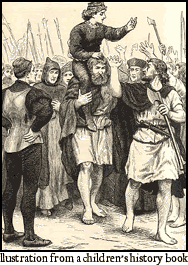
Lambert Simnel in Ireland - Wikimedia Commons Public Domain
Lambert Simnel in Ireland


There were also still many rumours circulating that at least one of the sons of Edward IV was still alive, and was possibly in hiding on the Continent or, possibly, in Ireland. These two young princes, Edward V and Richard, Duke of York had last been seen in public when they were living in the Tower of London in 1483 prior to Richard III seizing the throne. The sightings of the two young boys had petered out and there were strong rumours that they had been murdered, possibly by their uncle, Richard III.  So it was perhaps unsurprising that Henry VII had to put down rebellions raised in favour of these supposed Yorkist claimants to the English throne.  The first of these was in 1487 and was centred on a pretender known to history as Lambert Simnel. But Lambert Simnel is one of the real mystery people of history as, for a start, we do not even know if he really ever existed.


Back in the 15th century communications were not as good as they are now and there was certainly no global news flashing information across the miles in seconds.  For information on the events happening in these tumultuous years, we need to rely on the chroniclers of the time, many of whom were writing years after the event.  It is also worth bearing in mind that history tends to favour the victors and these chroniclers were writing for a Tudor monarchy. There are several chronicles that cover this period of Henry VII’s reign and they all give out conflicting information about the youth crowned in Dublin, as some say he was a genuine pretender and some say he was an imposter. The chronicle written closest to the event was that of Jean Molinet in 1490 and Molinet stated that the Irish King was the real Earl of Warwick. The story of Lambert Simnel most commonly used today comes from Polydore Vergil’s ‘Anglica Historia’ written between 1503 and 1513 which puts forward the belief that Lambert Simnel was a counterfeit Earl of Warwick. Then Bernard Andre wrote a life of Henry VII in 1500 that stated that Lambert Simnel was an impersonator of Richard, Duke of York, one of the Princes in the Tower.

So let us look at the story of Lambert Simnel from the very beginning. The pretender was thought to have been born around 1477 and came from humble origins.  His real name is actually not known, as in some contemporary records he has been referred to as John and we cannot be sure that Simnel was his surname. His parentage has also been questioned, with his father being named variously as a baker, a tradesman and even an organ builder. Indeed, it has even been proposed that the character of Lambert Simnel was a fake and constructed by Henry VII as a political ruse to deflect attention away from genuine Yorkist pretenders to the throne, such as the two missing princes.  The story goes that when Lambert Simnel was a young child he was taken in as a pupil by a priest called Roger Simon in Oxford. But again we have discrepancies as this priest is sometimes also known as Richard Symonds. Apparently Simon was much struck by the similarity in appearance between Lambert Simnel and the two young sons of Edward IV and decided that he would school him in courtly manners and knowledge of the Yorkist Court so that he could be used as an imposter for one of the missing princes. It is said that he initially intended to pass him off as the vanished Richard Duke of York, but that after he heard rumours that the Duke of Clarence’s son the Earl of Warwick had died in the Tower of London, he decided to change tack. It absurd to think that a lowly priest in Oxford could possibly educate a young lad to impersonate a prince, so Simon must have been in the pay of someone important who was still adhering to the Yorkist cause, most probably the Earl of Lincoln or Elizabeth Woodville, widow of Edward IV.

Christchurch Cathedral, Dublin  where Simnel was crowned
Christchurch Cathedral, Dublin  where Simnel was crowned


Simon then reputedly spread a rumour that Warwick had escaped from the Tower and was now under his protection. He then took Lambert Simnel to Ireland in early 1487 where there was still a strong Yorkist faction. He managed to get Simnel presented to the Earl of Kildare who was ruling Ireland on behalf of Henry VII at the time.  The Earl of Kildare either was taken in by the imposture or chose to buy into the story and agreed to back an invasion of England based on Simnel’s claim to the English throne as the Earl of Warwick and depose Henry VII. They had Simnel crowned in Christchurch Cathedral, Dublin as King Eward VI. It has to be said that the surviving Yorkists seemed to be happy to support anyone who would help them to overthrow Henry and get a Yorkist King back on the throne. Back in England, the Earl of Lincoln, who had been Richard III’s named heir, gave his support to this plot to supplant Henry.  He fled to the court of Burgundy and both his and Warwick’s aunt, Margaret, the Dowager Duchess.  When he arrived in Burgundy he made claims that he had assisted in the Earl of Warwick’s escape from the Tower, so as to make Simnel’s story look more authentic. He also joined forces with Francis, Viscount Lovell, one of Richard III’s strongest supporters, who had been cooling his heels in Burgundy since the Battle of Bosworth in 1485.


Henry VII, who had already developed a good intelligence network, was made aware of these developments and started raising his army.  Henry’s trump card of course is that he knew full well that the real Earl of Warwick was still alive and well in the Tower of London.  As a grand PR stunt and to persuade his nobles, he had the Earl of Warwick released from the Tower. Warwick was then led in procession from the Tower to St Pauls and taken to the royal palace at Sheen where he could be seen regularly and conversed with by the members of the court. There is also conjecture that Lambert Simnel could have been the real Earl of Warwick and that the lad imprisoned in the Tower was the imposter.  Warwick would not have been well known at Court as he had been kept at Sheriff Hutton Castle in Yorkshire before Bosworth and then kept in the Tower of London by Henry.  Remember, in those days there were no photos to match people to and even painted portraits were not reliable likenesses. The Earl of Lincoln, who was related to the real Warwick, was thought to have been in contact with this supposed Warwick during his time at Sheen. It could be telling that it was after this meeting that Lincoln fled to Burgundy, as he would have surely recognised his cousin, and maybe he saw that this youth was not Warwick but an imposter?

Henry then took this opportunity to suspect his mother-in-law Elizabeth Woodville, the mother of the Princes in the Tower, of being implicated in the plot and stripped her of her lands and revenues, sending her to end her days in a convent in Bermondsey. He also imprisoned her son Thomas Grey, Marquess of Dorset for the duration of the rebellion. He offered full pardons to any of the traitors who were willing to drop their rebellion and come back to Henry’s fold. But one of the questions that needs to be asked is why would Elizabeth Woodville lend her support to Warwick, the son of the Duke of Clarence who had been her implacable enemy?  Clarence had rebelled against his brother Edward IV several times, one of the reasons being his dislike of his brother’s marriage with a lowly Woodville widow. Elizabeth had strongly supported Edward’s actions in imprisoning and then executing his brother, so why would she support his son?  Especially as her daughter was married to Henry and currently Queen of England? Surely only one of her own sons would be worth risking the security of her daughter for? So was the Irish King actually really one of her sons? Could he have been the lost King Edward V or Richard, Duke of York?

The Irish contingent that the Earl of Kildare managed to gather together was headed by Thomas Geraldine. Margaret of Burgundy mustered 2,000 Flemish mercenaries under the command of the noted military commander Martin Schwartz and shipped them out to Ireland, where they landed on May 5th 1487. Lambert Simnel and his followers then took ship and landed in Furness in the north west of England on 5th June 1487, where they swiftly found that they were joined by only a few English supporters. Most of the local nobility, cautious Northerners, held back waiting to see which way the wind blew, with the notable exception of Sir Thomas Broughton. The rebel force marched south and eventually clashed with King Henry’s army at the Battle of Stoke Field in Nottinghamshire on 16th June. It was a bloody encounter and both Lincoln and Thomas Broughton were killed in the battle. Kildare was captured by Henry, although he was not executed and returned to Ireland to rule once more. Francis Lovell vanished without trace and was never seen alive again.  Again there are discrepancies regarding the priest Simon. One version is that Simon was captured and imprisoned for life, escaping execution because he was a priest. However, much earlier, in February of 1487, a priest called Simons had made a confession in St Paul’s Cathedral that he had taken the son of an organ maker from Oxford to Ireland and when there had promoted him as the Earl of Warwick and this Simons had not been with the rebels at the battle.

King Henry VII
King Henry VII


Probably because he was only a child of 10, although some sources stated that he was 15, legend has it that Lambert Simnel was spared by Henry VII. Probably Henry did not deem him to be an ongoing political threat, so Lambert Simnel was pardoned and was placed in the royal kitchens as a spit turner. In later life it is believed that he became a falconer and that he died sometime after 1534. So Lambert Simnel is a real mystery person of history. Did he really even exist or was he just a construct of Henry VII spun to the populace for political purposes? If Lambert Simnel did exist and was the person crowned in Dublin was he an imposter? And if so, who was he impersonating? The Earl of Warwick, Richard, Duke of York, or King Edward V? Or was he genuinely actually one of these historical personages? Will we ever really know the truth about Lambert Simnel?

Christchurch Cathedral image William Murphy Creative Commons Attribution Share Alike 2.0 Generic
King Henry VII image - Wikimedia Commons Public Domain
Lambert Simnel image - Wikimedia Commons Public Domain

Monday, 12 December 2011

Mystery People of History – Perkin Warbeck, Prince or Pretender?


Few mysteries of history have fascinated us as much and prompted so much speculation as the mystery of the disappearance of the Princes in the Tower.  Were the two young princes really murdered in their beds, and if so who by and why? Or were they somehow spirited away from the Tower of London in secret and taken to a safe place to live out their lives in obscurity?  Against the chaos and political instability of that period of English history known as the War of the Roses, it is perhaps not surprising then that several figures came forward during the reign of King Henry VII claiming to be one of the lost princes and becoming a focus for rebellion, and one of the most famous of these royal pretenders was a young man know as Perkin Warbeck.

After Henry VII defeated King Richard III at the Battle of Bosworth in 1485 and claimed the English throne by right of conquest, his main tasks were to secure his kingdom and win the loyalty of his nobles and people.  He married Elizabeth of York, the eldest daughter King Edward IV, in an attempt to further legitimise his claim to the English crown and unite the Lancastrian and Yorkist factions, even though to do this he had to overturn the ruling that had declared that she and all her siblings were illegitimate due to their father’s alleged pre-contract of marriage with Lady Eleanor Talbot.  But if Elizabeth of York and her sisters were once again recognised as being the legitimate children of Edward IV and Elizabeth Woodville, then so too were her two brothers, King Edward V and Richard, Duke of York.  Many historians consider that to have overturned this ruling, Henry VII must have believed that the two young princes were indeed already dead, as if either of the two boys were still alive, they had a much greater claim to the throne than Henry himself, and he knew that there were still powerful forces both in England and across Europe who would back a Yorkist claimant to the throne.


Perkin Warbeck

One of these powerful forces was Margaret of Burgundy, the sister of the two dead kings Edward IV and Richard III and the aunt of the Princes in the Tower, and it was at her Court that Perkin Warbeck first came to public attention and claimed the throne of England. It is not known whether Margaret of Burgundy genuinely believed that Perkin Warbeck was her nephew or whether she was fully aware that he was a fraud and groomed him in the ways of the Yorkist Royal Family in order to create a focus of rebellion against Henry VII.  The other major European player to get involved was King Charles VIII of France, and both he and Margaret officially recognised Perkin Warbeck as King Richard IV of England.  For a while Perkin Warbeck was feted across Europe, attending the funeral in Vienna of the Holy Roman Emperor, Frederick III, and gaining the recognition of his successor Maximilian I, spending time at the French Court in 1492 and then residing at the Court of Burgundy. However, in 1492 Charles VIII signed the Treaty of Etaples with England to prevent a threatened invasion of France and part of the treaty was an agreement to expel Perkin Warbeck from French territory.  Warbeck’s presence in Burgundy rattled Henry VII so much that he imposed a trade embargo on Flanders in 1493, even though this would lose England a great deal of revenue.

Perkin Warbeck’s first foray into rebellion against the English crown had been in 1491 when he arrived in the Irish city of Cork, which had long been a Yorkist stronghold. The good people of Cork thought that Warbeck was actually the Earl of Warwick, the son of the hapless George, Duke of Clarence, who had been attainted for treason and executed in the Tower of London after trying the patience of his brother Edward IV one time too many, who was currently being held captive by Henry VII.  Warbeck’s English was apparently not very good, but he managed to deny his being the Earl of Warwick and declare himself as Richard, Duke of York. However, little became of this rebellion and he was forced to return to Europe.


With the support of Margaret of Burgundy, he tried his hand again in 1495 and landed with a small force in Deal on the Kent coast.  His small force was effectively routed and Warbeck was forced to sail on to Ireland without even disembarking onto English soil.  Once in Ireland, he gained the support of the Earl of Desmond and laid siege to the town of Waterford, but was once again unsuccessful.  He fled to the Court of King James IV of Scotland, where he was graciously received, given a pension of £1200 a year and the hand of the Scottish King’s cousin, Lady Catherine Gordon, in marriage.  At that time James IV was happy to use any means at his disposal to rile Henry VII, so he encouraged Perkin Warbeck to use his pension for funding for attempting to mount an attack across the English border.  However, Warbeck received no support whatsoever from the English and was forced to retreat back into Scotland.  Henry VII may still at this point in his reign have felt insecure on his throne, but he had set up an effective network of spies and had rooted out and dealt with any English supporters of Perkin Warbeck.  In 1495, Sir William Stanley was tried and executed for treason due to his support of Warbeck and the Yorkist cause, which is ironic in the light of the fact that he was the very same William Stanley who switched sides at the Battle of Bosworth ensuring the defeat of the Yorkist King Richard III. Henry VII’s steward Lord Fitzwalter was also attainted and executed and it seems that they were being informed on by one of their co-conspirators Sir Robert Clifford, who was secretly working for Henry.  Clifford’s reward for his participation in the conspiracy against the crown was not the more usual short trip to the scaffold but a full pardon and a hefty reward.

After Warbeck’s failed attempt to enter England, James IV of Scotland gave up on the idea of being a thorn in the side of the English King, and signed the Treaty of Ayton that brought him peace with England and Henry’s daughter Margaret Tudor as a bride. Warbeck was once more expelled and returned again to Ireland to make another attempt at laying siege to the town of Waterford.  This attempt was swiftly defeated and he was chased from Ireland by four English ships.  Left with only a handful of supporters, Perkin Warbeck sailed to Cornwall, where he hoped to capitalise on the discontent still fomenting there after the uprising that had taken place only a few months earlier. The Cornish people welcomed him and declared him King Richard IV on Bodmin Moor.  The support of the Cornish swelled his army by 6000 and he marched on Exeter and then on to Taunton.  Henry sent an army to counter Warbeck’s rebellion, and when Warbeck heard that this force had sighted he fled to Beaulieu Abbey in Hampshire, where he was captured. Henry VII was initially merciful to Perkin Warbeck, allowing him to stay at Court under supervision.  However, he attempted to run away, so was removed to the more secure environment of the Tower of London.  In 1499 he allegedly tried to escape again, this time supposedly in the company of the real Earl of Warwick, and was hanged at Tyburn.


So was Perkin Warbeck really Richard, Duke of York?  It is popularly believed that he was actually a Fleming born in Tournai in around 1474, the son of a French official called John de Werbecque and his wife, Katherine de Faro, and that he had spent his boyhood years working as a servant in several different households. He then became an apprentice for a fleece merchant called Pregent Meno, and it was while he was working for Meno that he first arrived in Ireland and declared himself to be Richard, Duke of York.  Perkin Warbeck also supposedly bore a strong resemblance to the dead Yorkist monarch, Edward IV, and it has been speculated that Warbeck could actually have been Edward’s illegitimate son. But what of Margaret of Burgundy’s support of Perkin Warbeck.  Would she really have supported an imposter as her nephew?  Would she really have wanted a non-royal foreigner on the throne of England, however much she despised Henry VII’s regime?  She declared that she recognised Warbeck as Richard of York because of certain birthmarks on his body and his supposedly detailed knowledge of what life had been like living in the English Royal Household.  In return for Margaret’s support, Warbeck had to promise to return all her lands in England to her that had been confiscated after the Battle of Bosworth when he gained the English crown. But was this enough to make her support an imposter? 

Moreover, if Perkin Warbeck really spoke such poor English and was uneducated, would sophisticated monarchs like Maximilian I and Charles VII even have deigned to let him into their presence, let alone backed him as a pretender to the throne of England? In the 15th century class was all important, and people rarely moved out of the milieu into which they had been born.  There was also a mystique and a reverence surrounding royal blood, and preserving royal bloodlines and family ties was regarded as all important, so encouraging someone who had worked as a servant to make a bid for a crown would have been almost unthinkable.  After all, the real Richard, Duke of York had been excluded from the possibility of ever sitting on the throne of England purely because his father might have made a pre-contract of marriage with another woman before he married Richard’s mother Elizabeth Woodville.

Like all great historical mysteries, we shall never probably really know the truth about Perkin Warbeck.  Perkin Warbeck made a confession before his execution that gave his parentage and early history, some of which has been backed up by documentary evidence.  But was he forced into this confession by Henry VII, who would have been very eager to ensure that there was no doubt in anyone’s mind that that Perkin Warbeck was an imposter and not a Yorkist prince? Most likely he was just an apprentice from Flanders, who by chance bore an uncanny resemblance to a dead king and was in the right place at the right time, but there is always the chance, however slight, that he really was Richard of York and that he had been spirited away from his imprisonment in England and brought to Europe for safety.

Image Wikimedia Commons Public Domain