Showing posts with label Wars of the Roses. Show all posts

Saturday, 19 January 2013

Mystery People of History - Lambert Simnel


It is said that on 24 May 1487, a youth known as Lambert Simnel was crowned as King Edward VI in Christ Church Cathedral in Dublin in a bid to wrest the crown of England from the new Tudor monarch Henry VII. England in the latter part of 15th century had been torn apart by the War of the Roses, where the Lancastrian and Yorkist factions battled each other for supremacy and the crown passed back and forth between them several times.  It seemed in 1485 that when the Lancastrian Henry VII defeated Richard III at the Battle of Bosworth that the country was at last settled politically and it was the end of the battles and turmoil.  However, the Yorkist faction had not been entirely quashed and was still eager to seize power again and put a Yorkist claimant on the throne.  But who were the surviving claimants to the throne that the Yorkists could still fight for?   Richard III’s only son Edward of Middleham had died before his father, so Richard named his nephew John de la Pole, Earl of Lincoln as his heir.  However, Lincoln had come to an accord with Henry VII and seemed to have thrown his lot in with the Lancastrians. Another potential heir was the young Edward, Earl of Warwick who was the only surviving son of the late Duke of Clarence.  Clarence was the brother of both Edward IV and Richard III and he had been executed by Edward IV in 1478 for treason. After Bosworth, Henry VII removed Warwick from Sheriff Hutton Castle in Yorkshire and had him brought to the Tower of London.
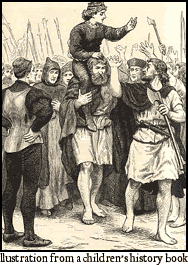
Lambert Simnel in Ireland - Wikimedia Commons Public Domain
Lambert Simnel in Ireland


There were also still many rumours circulating that at least one of the sons of Edward IV was still alive, and was possibly in hiding on the Continent or, possibly, in Ireland. These two young princes, Edward V and Richard, Duke of York had last been seen in public when they were living in the Tower of London in 1483 prior to Richard III seizing the throne. The sightings of the two young boys had petered out and there were strong rumours that they had been murdered, possibly by their uncle, Richard III.  So it was perhaps unsurprising that Henry VII had to put down rebellions raised in favour of these supposed Yorkist claimants to the English throne.  The first of these was in 1487 and was centred on a pretender known to history as Lambert Simnel. But Lambert Simnel is one of the real mystery people of history as, for a start, we do not even know if he really ever existed.


Back in the 15th century communications were not as good as they are now and there was certainly no global news flashing information across the miles in seconds.  For information on the events happening in these tumultuous years, we need to rely on the chroniclers of the time, many of whom were writing years after the event.  It is also worth bearing in mind that history tends to favour the victors and these chroniclers were writing for a Tudor monarchy. There are several chronicles that cover this period of Henry VII’s reign and they all give out conflicting information about the youth crowned in Dublin, as some say he was a genuine pretender and some say he was an imposter. The chronicle written closest to the event was that of Jean Molinet in 1490 and Molinet stated that the Irish King was the real Earl of Warwick. The story of Lambert Simnel most commonly used today comes from Polydore Vergil’s ‘Anglica Historia’ written between 1503 and 1513 which puts forward the belief that Lambert Simnel was a counterfeit Earl of Warwick. Then Bernard Andre wrote a life of Henry VII in 1500 that stated that Lambert Simnel was an impersonator of Richard, Duke of York, one of the Princes in the Tower.

So let us look at the story of Lambert Simnel from the very beginning. The pretender was thought to have been born around 1477 and came from humble origins.  His real name is actually not known, as in some contemporary records he has been referred to as John and we cannot be sure that Simnel was his surname. His parentage has also been questioned, with his father being named variously as a baker, a tradesman and even an organ builder. Indeed, it has even been proposed that the character of Lambert Simnel was a fake and constructed by Henry VII as a political ruse to deflect attention away from genuine Yorkist pretenders to the throne, such as the two missing princes.  The story goes that when Lambert Simnel was a young child he was taken in as a pupil by a priest called Roger Simon in Oxford. But again we have discrepancies as this priest is sometimes also known as Richard Symonds. Apparently Simon was much struck by the similarity in appearance between Lambert Simnel and the two young sons of Edward IV and decided that he would school him in courtly manners and knowledge of the Yorkist Court so that he could be used as an imposter for one of the missing princes. It is said that he initially intended to pass him off as the vanished Richard Duke of York, but that after he heard rumours that the Duke of Clarence’s son the Earl of Warwick had died in the Tower of London, he decided to change tack. It absurd to think that a lowly priest in Oxford could possibly educate a young lad to impersonate a prince, so Simon must have been in the pay of someone important who was still adhering to the Yorkist cause, most probably the Earl of Lincoln or Elizabeth Woodville, widow of Edward IV.

Christchurch Cathedral, Dublin  where Simnel was crowned
Christchurch Cathedral, Dublin  where Simnel was crowned


Simon then reputedly spread a rumour that Warwick had escaped from the Tower and was now under his protection. He then took Lambert Simnel to Ireland in early 1487 where there was still a strong Yorkist faction. He managed to get Simnel presented to the Earl of Kildare who was ruling Ireland on behalf of Henry VII at the time.  The Earl of Kildare either was taken in by the imposture or chose to buy into the story and agreed to back an invasion of England based on Simnel’s claim to the English throne as the Earl of Warwick and depose Henry VII. They had Simnel crowned in Christchurch Cathedral, Dublin as King Eward VI. It has to be said that the surviving Yorkists seemed to be happy to support anyone who would help them to overthrow Henry and get a Yorkist King back on the throne. Back in England, the Earl of Lincoln, who had been Richard III’s named heir, gave his support to this plot to supplant Henry.  He fled to the court of Burgundy and both his and Warwick’s aunt, Margaret, the Dowager Duchess.  When he arrived in Burgundy he made claims that he had assisted in the Earl of Warwick’s escape from the Tower, so as to make Simnel’s story look more authentic. He also joined forces with Francis, Viscount Lovell, one of Richard III’s strongest supporters, who had been cooling his heels in Burgundy since the Battle of Bosworth in 1485.


Henry VII, who had already developed a good intelligence network, was made aware of these developments and started raising his army.  Henry’s trump card of course is that he knew full well that the real Earl of Warwick was still alive and well in the Tower of London.  As a grand PR stunt and to persuade his nobles, he had the Earl of Warwick released from the Tower. Warwick was then led in procession from the Tower to St Pauls and taken to the royal palace at Sheen where he could be seen regularly and conversed with by the members of the court. There is also conjecture that Lambert Simnel could have been the real Earl of Warwick and that the lad imprisoned in the Tower was the imposter.  Warwick would not have been well known at Court as he had been kept at Sheriff Hutton Castle in Yorkshire before Bosworth and then kept in the Tower of London by Henry.  Remember, in those days there were no photos to match people to and even painted portraits were not reliable likenesses. The Earl of Lincoln, who was related to the real Warwick, was thought to have been in contact with this supposed Warwick during his time at Sheen. It could be telling that it was after this meeting that Lincoln fled to Burgundy, as he would have surely recognised his cousin, and maybe he saw that this youth was not Warwick but an imposter?

Henry then took this opportunity to suspect his mother-in-law Elizabeth Woodville, the mother of the Princes in the Tower, of being implicated in the plot and stripped her of her lands and revenues, sending her to end her days in a convent in Bermondsey. He also imprisoned her son Thomas Grey, Marquess of Dorset for the duration of the rebellion. He offered full pardons to any of the traitors who were willing to drop their rebellion and come back to Henry’s fold. But one of the questions that needs to be asked is why would Elizabeth Woodville lend her support to Warwick, the son of the Duke of Clarence who had been her implacable enemy?  Clarence had rebelled against his brother Edward IV several times, one of the reasons being his dislike of his brother’s marriage with a lowly Woodville widow. Elizabeth had strongly supported Edward’s actions in imprisoning and then executing his brother, so why would she support his son?  Especially as her daughter was married to Henry and currently Queen of England? Surely only one of her own sons would be worth risking the security of her daughter for? So was the Irish King actually really one of her sons? Could he have been the lost King Edward V or Richard, Duke of York?

The Irish contingent that the Earl of Kildare managed to gather together was headed by Thomas Geraldine. Margaret of Burgundy mustered 2,000 Flemish mercenaries under the command of the noted military commander Martin Schwartz and shipped them out to Ireland, where they landed on May 5th 1487. Lambert Simnel and his followers then took ship and landed in Furness in the north west of England on 5th June 1487, where they swiftly found that they were joined by only a few English supporters. Most of the local nobility, cautious Northerners, held back waiting to see which way the wind blew, with the notable exception of Sir Thomas Broughton. The rebel force marched south and eventually clashed with King Henry’s army at the Battle of Stoke Field in Nottinghamshire on 16th June. It was a bloody encounter and both Lincoln and Thomas Broughton were killed in the battle. Kildare was captured by Henry, although he was not executed and returned to Ireland to rule once more. Francis Lovell vanished without trace and was never seen alive again.  Again there are discrepancies regarding the priest Simon. One version is that Simon was captured and imprisoned for life, escaping execution because he was a priest. However, much earlier, in February of 1487, a priest called Simons had made a confession in St Paul’s Cathedral that he had taken the son of an organ maker from Oxford to Ireland and when there had promoted him as the Earl of Warwick and this Simons had not been with the rebels at the battle.

King Henry VII
King Henry VII


Probably because he was only a child of 10, although some sources stated that he was 15, legend has it that Lambert Simnel was spared by Henry VII. Probably Henry did not deem him to be an ongoing political threat, so Lambert Simnel was pardoned and was placed in the royal kitchens as a spit turner. In later life it is believed that he became a falconer and that he died sometime after 1534. So Lambert Simnel is a real mystery person of history. Did he really even exist or was he just a construct of Henry VII spun to the populace for political purposes? If Lambert Simnel did exist and was the person crowned in Dublin was he an imposter? And if so, who was he impersonating? The Earl of Warwick, Richard, Duke of York, or King Edward V? Or was he genuinely actually one of these historical personages? Will we ever really know the truth about Lambert Simnel?

Christchurch Cathedral image William Murphy Creative Commons Attribution Share Alike 2.0 Generic
King Henry VII image - Wikimedia Commons Public Domain
Lambert Simnel image - Wikimedia Commons Public Domain

Thursday, 15 March 2012

Lord Stanley – A Man for All Allegiances


One of the most difficult choices that any 15th century English nobleman had to make was where his loyalties lay.  In theory it should be a simple matter of pledging his loyalty to the King, but in the troubled times of the War of the Roses the political terrain was a great deal more complicated, and there were tangled family ties and loyalties to consider as well as a duty to crown and country.  In this conflict some men would lose their lives for their loyalty, some would be executed for their disloyalty, but there was one nobleman who managed with great dexterity to play on both sides at once and keep his head very firmly on his shoulders.  This politically adroit baron was Thomas Stanley, 1st Earl of Derby, who throughout his long career would seamlessly slip between support for the Lancastrian cause and the Yorkist cause, and then found that he could just as happily embrace the new Tudor monarchy, just so long as he was well rewarded and retained his titles, estates and fortune.

Thomas Stanley, 1st Earl of Derby


He was born in 1435 and was the eldest son and heir of Thomas Stanley, 1st Baron Stanley and his wife Joan Goushill.  Through his mother he was related to the royal family, as she was a descendant of the great warrior King Edward I.  The Stanley family wielded great influence in the North West of England and during his life Lord Stanley would own great estates, such as Lathom House and Tatton Park, in Cheshire and Lancashire.  He was introduced to public life at the royal court early and in his youth he acted as one of King Henry VI’s squires.  He seemed at this stage of his career to be a loyal and staunch follower of the King, but the political scene in England was just about to get a whole lot more complicated and Stanley was to produce a master class in how to navigate your way successfully through tricky, dangerous situations with your skin in one piece and adding to your power and possessions along the way. In 1457 he married Eleanor Neville who was the daughter of the powerful baron Richard Neville, Earl of Salisbury.  Her brother was Richard Neville, Earl of Warwick and at this time the Neville family were strongly promoting the cause of the Duke of York.

In 1459 Stanley’s father died and he inherited his titles and great estates, including the title of King of Mann.  He was now a very important and influential baron, and one that England’s monarch needed to keep on side if at all possible. King Henry had been in Yorkist hands since the first Battle of St Albans in 1455, but the discontent between the two factions rumbled on and came to a head in 1459, when Richard of Salisbury put his forces into the field of battle against the King’s men at the Battle of Blore Heath.  Henry VI’s French wife, Queen Margaret of Anjou, was the real power behind the throne, as her royal husband was a feeble and ineffectual monarch, and had at one time slipped into a catatonic state that lasted many months. In the male dominated, warrior climate of the late Middle Ages, the barons respected power, leadership and skills in battle, and as far as many of them were concerned a simpleton like Henry, whose only interest seemed to be religion, just did not cut the mustard, and his closest supporter were thought by the Yorkist faction to be corrupt and avaricious.


Margaret of Anjou wanted her husband back as he was an important part of her power base, and gave orders that Stanley was to raise an army to stop Salisbury, who was marching through the Midlands, from linking up with the main Yorkist forces in Ludlow. But although he had 2,000 men-at-arms at his disposal, he chose to sit the battle out.  His brother, Sir William Stanley, threw his hat into the ring and fought on the side of the Yorkists and got attainted for his troubles.  That Lord Stanley was secretly supporting the Duke of York and his faction, is borne out by allegations that he had managed to prevent a number of Cheshire levies from fighting on the Lancastrian side and had also managed to covertly help the Yorkists.  Blore Heath was a savagely fought and bloody battle that was won by Salisbury and cost the life of the Lancastrian battler commander Lord Audley.  However, just to make sure that he was covered on both sides, after the battle Lord Stanley sent his congratulations on the victory to the Earl of Salisbury and wrote to the Queen to offer his apologies and excuses for why he had not seen fit to commit his men to the battle. Margaret of Anjou cannot have been too convinced or impressed by his explanations, but nevertheless when Parliament petitioned for his attainder later that year they were not successful; in the fluctuations of the Wars of the Roses she needed all the friends and support that she could get, even those as unreliable as the slippery Lord Stanley.

Lord Stanley joined the Yorkist Council soon after the Battle of Blore Heath, when Richard, Duke of York dropped his bomb shell that he wanted to claim the crown of England himself, rather than just be the most influential baron guiding Henry VI’s royal career. This naturally did not go down well with Margaret of Anjou, who wanted the English throne for her young son Edward of Lancaster. She managed to eliminate her nemesis the Duke of York and his key supporter the Earl of Salisbury at the Battle of Wakefield in December 1460, and had their heads put on public show on the Micklegate Bar in York, along with those of York’s son Edmund, Earl of Rutland and Richard Hanson. The Queen’s forces defeated the Earl of Warwick at the second Battle of St Albans early in 1461 and regained possession of the King, but were then decisively defeated in March of the same year by an army led by Edward Earl of March, the Duke of York’s eldest son.  Edward had himself crowned as King Edward IV and Margaret, having once more lost possession of her husband, fled to France via Wales and Scotland. Lord Stanley had demonstrated his usual survival skills and had not fought at either Wakefield or Towton, though he had aided the Earl of Warwick in besieging some northern castles that held for Lancaster.  The Earl of Warwick was now one of the most powerful men in England, as well as being Stanley’s brother-in-law and it seemed that at this time the two powerful barons enjoyed cordial relations.  However, as history was to show, family loyalty would not be enough to ensure Stanley’s support, as this was a man who always liked to come out on the winning side.


The honeymoon period for the new Yorkist monarch was not destined to last for very long, as fractures in the relationship between Edward IV and Warwick soon began to show.  Warwick was known as the ‘Kingmaker’ and expected to be well rewarded by the new monarch as well as to be the key influence on royal policy. But although he was young, and grateful for Warwick’s aid in putting him on the throne, Edward IV had a mind of his own and liked to make his own choices.  While Warwick was trying to secure a diplomatically useful match for him with a French princess, Edward was dallying with a Lancastrian widow behind his back.  He married this widow, Elizabeth Woodville, in secret and when Warwick found out he was furious.  Further salt was rubbed in his wounds when Edward IV started arranging very favourable matches for her very large family, some of which were detrimental to Warwick’s own family. Lord Stanley was married to Warwick’s sister Eleanor Neville, but when Warwick, aided and abetted by Edward IV’s own brother the Duke of Clarence, rebelled in March 1470, Lord Stanley did not step in to help him. Stanley then did an about turn when Warwick, having fled to France and allied himself with Margaret of Anjou, returned in 1471 to England to place the hapless Henry VI once more on the throne. To all outward appearances it seemed as though Lord Stanley had thrown his lot in with the Lancastrian cause, but as usual looks were deceiving.  His brother William hastened to Edward IV’s side when he landed at Ravenspur to reclaim his throne, but as usual big brother Thomas hung back and took no part in the Battle of Tewkesbury which saw Margaret’s forces decisively defeated and the young Edward of Lancaster killed.


The newly restored King Edward IV decided to give the powerful magnate the benefit of the doubt, and rewarded Stanley’s non-participation in the conflict by appointing him steward of the king’s household and inviting him to sit on the royal council.  Very conveniently for him, his ties to the dead and discredited Earl of Warwick were severed when his Neville wife Eleanor died in 1472.  He promptly married Margaret Beaufort, the dowager Countess of Richmond.  This was not an obvious match for a supposedly fervent supporter of the Yorkist monarchy, as her son Henry Tudor was the last surviving Lancastrian claimant to the throne and was living in exile in Brittany. However, throughout Edward IV’s reign he played the part of a loyal subject, accompanying his King to France on campaign in 1475 and being awarded a pension by the French king Louis XI at the treaty of Picquiny, and he also fought in Scotland with the king’s brother, Richard, Duke of Gloucester in 1482, and helped him capture the key town of Berwick-upon-Tweed.

It was the unexpected death of Edward IV in 1483 that once more upset the political apple cart. The King’s heir was his eldest son, who became Edward V.  His uncle, Richard of Gloucester, had been appointed Lord Protector and arranged to meet the delegation, including several of the new king’s Woodville relatives, who were accompanying Edward V to London at Stony Stratford. A fracas broke out, and the Duke of Gloucester secured possession of the new monarch and took him to reside in the Tower of London.  This was not the odd choice that it may seem, as the old Norman fortress was where monarchs traditionally lived in the days before their coronation.  Elizabeth Woodville had fled into sanctuary at Westminster with the rest of her family, and there were repeated rumours of plots and conspiracies.  One of these erupted in June 1483 when Richard stormed a royal council meeting being held at the Tower and arrested several of the noblemen in attendance.  Lord Stanley was injured in the ensuing scuffle and briefly imprisoned, but Lord Hastings was condemned on the spot and summarily beheaded.

Richard seized the throne for himself and was crowned King Richard III. Lord Stanley had obviously been fully forgiven, although maybe not entirely trusted as his eldest son Lord Strange was married to a niece of Elizabeth Woodville, as he was allowed to carry the mace at Richard’s coronation and his wife, Margaret Beaufort, carried Queen Anne’s train.  He was also allowed to carry on in his role as the steward of the king’s household and joined the Order of the Garter, taking over the executed Lord Hasting’s vacant stall.  This was an age which did not allow for sentiment, and Lord Stanley was not a nobleman who would have worried overly much about sitting in a dead friend’s chair.  His survival skills were once more called upon late in 1483, when King Richard’s closest advisor, the Duke of Buckingham rebelled.  Despite the fact that his own wife, Margaret Beaufort, and her crony Morton were deeply implicated in the plot as they were brokering a marriage between Elizabeth of York and Henry Tudor, Stanley and his brother William helped the King suppress the rebellion.  The Duke of Buckingham lost his head, Margaret Beaufort was formally placed in her husband’s custody to keep her out of trouble, Morton had to make himself scarce and once more Lord Stanley was lavishly rewarded with estates forfeited by the rebels and Buckingham’s position of High Constable of England.  It was perhaps the biggest mistake that Richard III ever made that he did not execute Margaret Beaufort and put an end to her intrigues and plotting on behalf of her son Henry Tudor, but although retribution for men was often swift and savage during the Wars of the Roses, executing nobly born women would not become the rage until Tudor times.

Richard III endured the death of his only son and heir and then his wife Anne Neville during his short reign, and then in 1485 he had to face an invasion by the forces of Henry Tudor. Lord Stanley asked permission to leave court at this time, but Richard evidently did not trust him as he made him leave his oldest son Lord Strange in custody as a pledge for his continued good behaviour.  Both he and his brother William were, however, in contact with Henry Tudor when he landed in Wales and without Sir William’s lack of intervention his forces would never have been able to progress into England as they did.  Both the Stanley brothers were ordered by King Richard to raise an army to support him, and when the King discovered that Sir William had effectively cleared the path for Henry Tudor, he ordered his older brother to join him immediately.  Lord Stanley suddenly discovered that he was too unwell to answer his King’s summons and when his son, Lord Strange,  was caught trying to escape from Richard’s clutches, he admitted that both he and Sir William had been plotting with Henry Tudor. It has been said that Richard III gave orders that Lord Strange be executed during the Battle of Bosworth, to which Stanley’s response was reputedly ‘Sire, I have other sons’.  Fortunately for Lord Strange, the orders were never carried out.

So there were four armies headed towards Bosworth on that fateful day in August 1485, Richard III’s, Henry Tudor’s, Sir William Stanley’s and Lord Stanley’s. Take a guess as to whose army once again didn’t take an active part in the battle? As had happened several times before, Lord Stanley kept his fighting men out of the proceedings, although it is thought that he may have met with Henry Tudor on the eve of the battle. Sir William was once again a little bolder and intervened in the fighting and helped win the day for Henry Tudor. King Richard III was slain in the fighting, and Lord Stanley, despite his earlier absence, was conveniently on hand to pick up Richard’s fallen crown and place it on the head of the new king, Henry VII.  In a move that perhaps signalled the future ruthless nature of the new Tudor dynasty, Henry VII conveniently dated the start of his new reign to the day before the Battle of Bosworth, declaring all those who had fought against him traitors. So Lord Stanley’s stepson was the new King of England and as usual he reaped the rewards, becoming Earl of Derby in October 1485 and in the following year he was confirmed as the High Constable of England and appointed High Steward of the Duchy of Lancaster.  When Henry VII’s first son was born in 1486, he was chosen as godfather for the infant Prince Arthur, and it looked as though from that point on life would be relatively plain sailing for the all powerful baron.

However, the Yorkists had not quite yet run out of steam and in 1487 a rebellion was raised in support of a pretender called Lambert Simnel, who was supposedly Richard, Duke of York, one of the Princes in the Tower.  Henry Tudor must have been quite relieved when Lord Stanley did actively participate in putting this rebellion down, and did not stand aside hedging his bets as usual.  After the Battle of Stoke, he once again reaped great rewards for his assistance and was given lands forfeited by the rebels, which included the estates of Francis Viscount Lovell, Sir Thomas Broughton and Sir Thomas Pilkington. He once again in 1489 helped the Tudor monarch to suppress a rebellion in Yorkshire, but his brother Sir William Stanley eventually slipped up by backing the wrong side when he fought for the pretender Perkin Warbeck and was executed for his treason.

Lord Stanley died at his estate of Lathom House in Lancashire on 20th July 1504, and was buried among his ancestors in the family chapel of Burscough Priory.  His eldest son Lord Strange had already died, so he was succeeded by his grandson Thomas, who became the 2nd Earl of Derby.  For a nobleman who had played such a prominent political role throughout the Wars of the Roses, he was very fortunate to have died naturally at home, instead of on a battlefield or on the scaffold.  It had taken great skill to not only have stayed alive, but to have enriched himself and his family in the process, even though no monarch, however powerful, could ever completely rely on his loyalty or support.  Expediency was his watchword and Lord Stanley’s allegiances would shift in the winds of change, always ready to altered and adjusted if the situation demanded it.

Thomas Stanley image Wikimedia Commons Public Domain